Vision Modelling. Part Three. Geometry of Vision
1 Excursion into the eye — 2 Perception — 3 Geometry of vision — 4 Eye tracking — 5 How to catch the gaze — 6 Modelling eye tracking
This part is important for understanding the principles of modelling eye tracking, and along the way it applies the knowledge of how the retina works from the second post.
Visual acuity
Five types of visual acuity are known:
- Detection acuity — the detection of an object in the field of view, for example a dot on a white background
- Localisation acuity — the ability to determine whether two lines whose ends touch are a continuation of each other, or whether one of them is displaced relative to the other
- Resolution acuity of the eye — the ability to perceive a boundary between discrete patterns unconnected with one another (for example, how sharply a fill pattern is seen and how it is oriented)
- Recognition acuity — familiar to anyone who has visited an oculist and chosen spectacles with the help of a Golovin–Sivtsev chart by recognising letters
- Dynamic acuity — the ability to distinguish motion
For the theme of modelling, the first three kinds of acuity are of the greatest interest.
A parameter common to all kinds of acuity is the visual angle, which determines the size of the stimulus’s projection on the retina. The visual angle is determined by elementary trigonometry as
where – the sought angle, S is the linear size of the object, and D is the distance from the object to the retina.
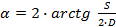
The formula applies exclusively to a visual angle not exceeding 10 degrees, and here is why: the greatest visual acuity corresponds to the region perceived by the central fovea of the retina. As one moves away from the fovea, the concentration of cones per square millimetre decreases (while the number of rods increases, which is why peripheral night vision is sharper than directed night vision), the sizes of the receptive fields grow, and because of this visual acuity, including the acuity of colour perception, falls sharply:
The diameter of the central fovea is 1 degree, the diameter of a receptor of the central fovea is 0.25 degrees, the inner edge of the blind spot lies 12 degrees toward the nose, and its size is 7.5 vertically and 5 horizontally.

So then, within these 10 degrees of maximal visual acuity, if one uses the visual angle to determine acuity, the optimal values for all types of acuity are roughly equal and amount to
- 0.5 seconds of arc for detection acuity
- 2 seconds of arc for fine adjustment (the determination of a quantitative parameter)
It is worth noting that although peripheral vision is inferior to foveal vision, the edges of indistinct stimuli perceived by peripheral vision seem sharper than they really are.
A figure to demonstrate the rapid decrease of visual acuity as the distance increases between the stimulated region of the retina and the central fovea. The elements of the figure are arranged in such a way that, when the gaze is fixed on the central point, all the letters will be clearly visible. This happens because, however much the distance may increase, the projection of each letter on the retina decreases, yet the number of receptors processing the letter remains roughly the same:
Besides the factor of angular distance from the optical axis, the duration of fixation also has a substantial influence on visual acuity: the longer a stimulus is examined, the more distinctly it is seen.
Saccades
A reasonable question arises: why, then, with so small an optical visual angle, do we perceive the world not as if looking through a rolled-up newspaper, but far more widely? The answer to this question is saccades.
Saccades (from the French saccader — to jerk) are abrupt movements of the eyes that quickly shift the gaze from one object to another.
There are small saccades (less than 3 degrees of the visual field) and large ones (20 degrees and more). Saccades are movements of a ballistic type: they have a concrete goal and direction; what is more, if the target object moves, the saccade will not break off and follow the object, but will finish at the place where the object was before (the effect of “it moved so fast that one could not keep up with it”).
Saccades are performed very quickly; as a rule the number of saccades is from 1 to 3 a second, but they are performed so rapidly that they occupy no more than 10% of the total time.
In fact, the eye-tracking technology toward whose modelling I am leading you is a technology for tracking saccades from an image of the pupils recorded by an infrared camera.
Besides the saccades themselves there are also microsaccades, performed when one tries to hold the gaze in one place. Microsaccades are reflex movements of the eyes by fractions of a degree of arc, in order to refresh the image on the retina.
The point is that the retina works in such a way that it can catch exclusively changes in the picture — that is, the retina was originally devised only for the perception of motion.
For example, if one puts on a contact lens and marks a dot on it, then for the first moments after the lens has been put on the dot will appear in the field of view and will be visible. After a few seconds, however, the dot will cease to be perceived by the retina and will disappear from the field of view. That is precisely why nature had to make a patch in the form of microsaccades, so that we could perceive static pictures.
Since microsaccades are a technical mechanism exclusively for the perception of static scenes, I shall say nothing more about them, for that would go beyond the theme of the post.
1 Excursion into the eye — 2 Perception — 3 Geometry of vision — 4 Eye tracking — 5 How to catch the gaze — 6 Modelling eye tracking