Vision Modelling. Part Five. How to Catch the Gaze
1 Excursion into the eye — 2 Perception — 3 Geometry of vision — 4 Eye tracking — 5 How to catch the gaze — 6 Modelling eye tracking
Continuing the account begun in the fourth part about saccades and their modelling, it is necessary to speak of such phenomena as traps for the gaze and zones of indistinguishability.
What are traps for the gaze?
The phenomenon of gaze traps is connected with the way consciousness ranks the degree of attractiveness of the next region of an image after a saccade. Involuntary saccades arise when it becomes necessary to subject a region to a more detailed inspection.
The result of the work of traps for the gaze is areas of pictures that either spontaneously draw attention to themselves, or on which, without extra effort, it is quite impossible to concentrate. Examples of such traps may be geometric figures whose ability to catch the gaze is based on visual ranking by colour.
Why does this happen? To understand it one needs to recall the information given in the second part, and specifically about complementary colours: a colour of a given brightness, surrounded by a background of the complementary colour, tends to be perceived by consciousness more strongly. Another effect of the perception of colour boundaries is the fact that a boundary between colours that are neighbours on the colour circle tends to be perceived by consciousness as less important, less sharp:
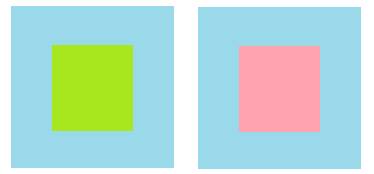
The boundary between the pink and the blue square (on the right) is perceived more sharply than that between the blue and the green (on the left). As a result, in the left-hand picture the strength of perception of the boundary between the squares turns out to be less than the strength of perception of the boundary between the blue square and the background. Because of this, one has the sensation that the gaze “runs” from the centre, being “drawn” to the outer contours of the blue square. In the second case (the picture on the right) the blue square strengthens the perception of the inner square, so that the centre of the figure begins subjectively to attract the gaze.
But the contours given in the example are open and are not able to hold attention for long; let us try properly to catch the wandering gaze:
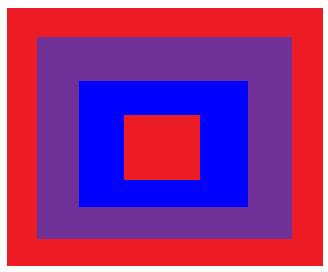
The figure in the picture consists of several nested contours whose colour boundaries are joined in such a way that the gaze constantly “avoids” the outer boundary and is “drawn” toward the inner ones.
As soon as the gaze fixes the boundary of some contour (for example, the red square in the centre), it immediately sees a more attractive, “complex” boundary to the side, and accordingly performs a small saccade in that direction. After which it sees what? That’s right! That yet another attractive boundary is observed to the side.
Because of reflex assessments of the strength of perception of boundaries, a gaze caught in the trap will dart for a long time between the central red square and the blue contour surrounding it.
Contours and the strength of perception
Exactly the same trick can be played using, for a subjective estimate of the “strength of boundaries”, not colours (or not only colours), but the complexity of contours. The simplest example is the following picture:
Looking at the left-hand picture. The fixation of attention on it is transferred between the centre (the red point in the picture on the right), where the subjectively most complex contour is found (the greatest density of crowded, variously directed, clearly distinguishable curves), and a point below the triangle, between the figure and the border (the blue point in the picture on the right), which, when the gaze is fixed at the centre, has in its vicinity the next most complex contour to study.
What is more, this set of contours, as a result of the involuntary fixation of the gaze at two points, will most probably be remembered as “a thingamajig with a squiggle on the left and a triangle at the bottom”!
Complexity, or the strength of perception, may also be dictated by emotionally recognisable contours. It is known, for example, that regions identified by the brain as a face, eyes and lips “attract the gaze”. Clearly distinguishable contours of the lips and eyes on the contour of a face may form pairs and triads of centres that draw attention. It is precisely because of this that, when recalling some photograph or painting, people often share the impression that “her blue eyes and sensual lips attracted the gaze”.
Traps for the gaze not only dictate the trajectories of saccades, but also determine the impression and the recollection of the picture that has been seen!
Another kind of contour that makes up traps for the gaze is subjective contours:
In the picture an outlined circle, a triangle and a half-ring are clearly visible, which in reality are not drawn.
Subjective contours arise after the primary processing of the picture by consciousness and are stronger than ordinary contours.
By the way, the illusion of three-dimensionality created when one looks at a two-dimensional picture possesses a greater subjective attraction than a picture perceived as two-dimensional.
The difference in the strength of perception of a two-dimensional and a “three-dimensional” contour.
The structure of a trap for the gaze
A gaze trap consists of a pair or a triad of equally distant centres of attention.
Each centre of attention is formed in one of the following ways (in order of decreasing strength of perception):
- A psychologically active contour (a face, the image of a familiar object (a shovel), recognisable contours of digits and letters)
- Subjective contours and regions perceived as three-dimensional.
- Colour contours (or, more precisely, the area near the boundary of a colour contour) with the maximal strength of perception.
- Complex contours composed of a multitude of clearly distinguishable segments.
At the same time one needs to understand that if several contours of different types are present at once in the zone of visibility, the eye will first pick out the stronger of them, and upon a repeated, deeper examination — the weaker ones. Thus, the “attractive force” of a region for the eyes is a composition of the strength of all distinguishable contours, taken in proportion to their significance.
The size of the contour of a centre of attention must not exceed the optical visual angle of the eye (a contour seen by peripheral vision is perceived less strongly because of the resolving power of the eye), provided that the centre lies in the zone of maximal visual acuity. On the other hand, the contour must be clearly distinguishable by lateral vision. Thus the dimensions of the contour around a centre of attention must be no smaller than 5 and no larger than 11 degrees, and the formation of the contour involves curves no shorter than 10 minutes of arc.
The centres of attention must be arranged in such a way that the distance between them is no less than 17 and no more than 35 degrees. In that case, when a centre of attention is surveyed by peripheral vision, the second centre of attention will be caught and a reflex saccade will be made toward it.
Zones of indistinguishability
As a result of the appearance of the phenomenon of a trap for the gaze there also appears the phenomenon of zones of indistinguishability — regions of the image that subjectively repel the gaze. Zones of indistinguishability are formed between centres of attention at the point of their “equilibrium”. Parts of a contour and objects that have fallen into a zone of indistinguishability are observed exclusively by peripheral vision, which possesses weak resolution, and attention is not concentrated on them.
It is with this effect that the fact is connected that, when reading long words, the eye needs to distinguish precisely the letters at the beginning of the word, the symbols at the end, and the overall contours (the length) of the constituents. A side psychological effect is that objects in zones of indistinguishability are usually not remembered by consciousness.
1 Excursion into the eye — 2 Perception — 3 Geometry of vision — 4 Eye tracking — 5 How to catch the gaze — 6 Modelling eye tracking